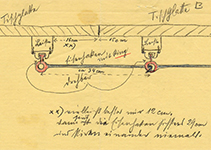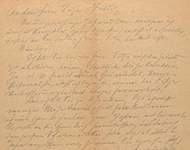
“Dear Mr. Schönberg! Herr Gropius passed on your letter to my attention some days ago. This seems such an interesting assignment and I would welcome the opportunity. But the solution is not so simple.
Select your language
“Dear Mr. Schönberg! Herr Gropius passed on your letter to my attention some days ago. This seems such an interesting assignment and I would welcome the opportunity. But the solution is not so simple.
The PMB (Personen der Moderne Basis) is a web service for people, works, institutions, places, and events relating specifically to Vienna around 1900. Its primary function is to create a shared database for various research projects. Currently, the authority file contains 49,310 people, 16,254 places, 29,153 works, 13,321 events, and 2,815 institutions, together, they form 196,257 relations.
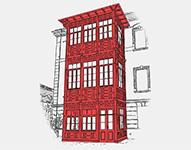
From 1918 to 1925, Arnold Schönberg lived at Bernhardgasse 6 in Mödling. The wooden veranda of the house bears witness to numerous visits by friends, students, and fellow composers from around the world — a vibrant place of artistic exchange and inspiring encounters.
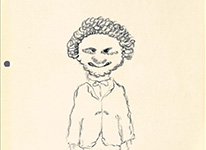
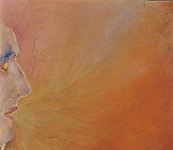
“Caricatures of people, most of them I met only in Hollywood. Some of them are more cruely exposed than I would have liked. I only disliked a few of these people. I cannot even tell anymore, whom some of the caricatures are meant to depict. Obviously these persons have totally disappeared from my life. Curiously, some of these are among the best I’ve done in terms of drawing technique as well as conception, as for example.” (Arnold Schönberg)
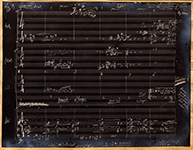
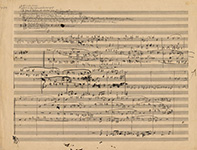
In 1929, Schönberg was commissioned by Heinrichshofen Verlag in Magdeburg to compose a film score. He oriented himself upon the key words “threatening danger, fear, catastrophe.” The original manuscript, stored at Heinrichshofen, was destroyed when a bomb was dropped on the publishing house in World War II. Schönberg retained this negative print of his autograph copy.
Ping-pong and twelve-tone method, house pets and ideological beliefs, telephone connections and faith-based opera: visits to the homes of Arnold Schönberg (1874 –1951) reveal constellations that illuminate his biography, creativity, and contemporary history in his central position as a major figure in transatlantic cultural history.
This edition of letters sheds light on the relationship between Arnold Schönberg and his publishers, and his working environment. The correspondence exchanged between the composer and the music publishers Dreililien and Universal-Edition comprises 1,750 written documents spanning four decades.
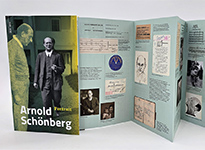
Arnold Schönberg’s life worlds in Europe and the USA unfold in an accordion booklet: compositions, performances, writings, paintings and drawings, teaching, interests and visions, private insights, and fingerprints of a century-defining figure in music.
The Arnold Schönberg Center’s website has undergone a complete redesign, enhancing both its visual appeal and functionality. The modern updates improve usability, with structured navigation and an upgraded search function making it easier to explore the center’s wide range of content. A new section, “Outreach,” brings together the growing range of masterclasses and educational programs offered in recent years. The site is constantly updated with new content, so there are always new features to discover!
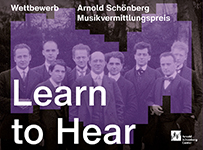
The Schönberg Music Mediation Award LEARN TO HEAR, initiated by the Arnold Schönberg Center and in cooperation with the Department of Music Education Research, Music Didactics, and Elementary Music Education (IMP) of the mdw-University of Music and Performing Arts Vienna, will be awarded for five consecutive years having started in 2023.
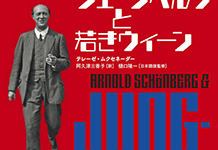
A study by Therese Muxeneder on the composer’s Jung-Wien environment has been published as a Japanese translation by Mikako Akutsu.
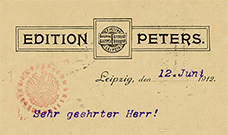
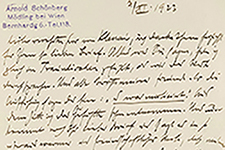
Recently we were able to purchase a letter for our Archive that was sent to the director of a printing works by Arnold Schönberg in 1922. The document refers to the upcoming publication of the 3rd edition of his “Harmonielehre” by Universal-Edition in Vienna.
The archive of the Schönberg publishing house Belmont Music, which was completely destroyed in the Pacific Palisades fire in Los Angeles, is being digitally reconstructed at the Arnold Schönberg Center in Vienna. The cultural transfer between the two Schönberg worlds continues.
To the Los Angeles Times article
Larry Schoenberg in his statement: The entire inventory of sales and rental materials – comprising some manuscripts, original scores, and printed works – has been lost in the flames.
Link: Facebook-Posting by Randy Schoenberg
At an auction in Vienna, we were able to acquire six letters from Arnold Schönberg to the Danish conductor and composer Paul von Klenau dating from 1923 and 1924 for our archive.
All of the composer’s paintings and drawings owned by the Schoenberg family (Los Angeles and Venice) have recently become the property of the Arnold Schönberg Center Private Foundation.
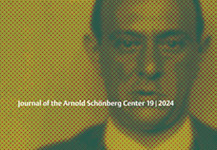
The current issue of the Journal of the Arnold Schönberg Center is being published as an open access journal.
ESTEEMED DIRECTOR
A new digital edition of letters will provide access to Arnold Schönberg’s relationship with his publishers and his working environment. The correspondence between the composer and the music publishers Dreililien and Universal-Edition comprises 1,600 documents spanning four decades.
September 13, 2024 marks the 150th anniversary of Arnold Schönberg’s birth. To commemorate this anniversary, the Arnold Schönberg Center, in cooperation with the Capital of Culture Bad Ischl – Salzkammergut 2024, is presenting an extensive exhibition with items from Schönberg’s estate as well as international collections.