

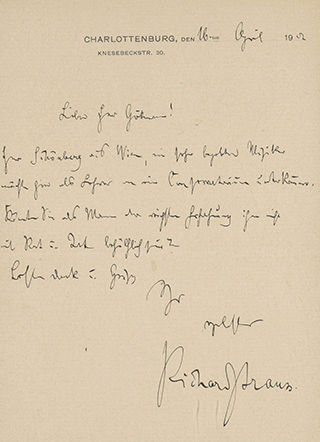
Our archive recently acquired a letter from Richard Strauss recommending the “very talented musician” Arnold Schönberg for a teaching position at a conservatory.
In mid-December 1901, Schönberg moved to Berlin and took up a position as music director at “E. von Wolzogens Buntes Theater (Ueberbrettl) G.m.b.H.” His duties failed to meet either artistic or financial expectations. The theater company soon ran into financial difficulties. Schönberg, who had to support a growing family (his daughter Gertrude was born in Berlin in January 1902), had to start looking for a new position.
At the beginning of February 1902, Alexander Zemlinsky asked his brother-in-law Schönberg to visit Richard Strauss and ask for help in getting his latest works performed. The meeting eventually took place in Charlottenburg in mid-April. Schönberg handed over the score of his string sextet “Verklärte Nacht,” op. 4, and also informed Strauss of his teaching activities in the field of music theory. On April 16, Strauss sent a letter of recommendation for Schönberg to Gustav Adolf Göttmann, a well-known music pedagogue, composer, music director, and critic.
Dear Mr. Göttmann!
Mr. Schönberg from Vienna, a very talented musician, would like to become a teacher at a conservatory. Could you, as a person with great experience, advise him on a course of action?
Many thanks and best regards
Yours
respectfully
Richard Strauss
Only one other letter of recommendation from Strauss to the director of the Stern Conservatory, Gustav Hollaender, on November 5, 1902 bore fruit. Hollaender gave Schönberg a position as a music theory teacher. Additionally, the first performance of Schönberg’s string sextet “Verklärte Nacht” in the Great Hall of the Architektenhaus in Berlin on October 30, 1902 had a connection with Strauss, whose String Quartet, op. 2 was also performed at that concert.

