

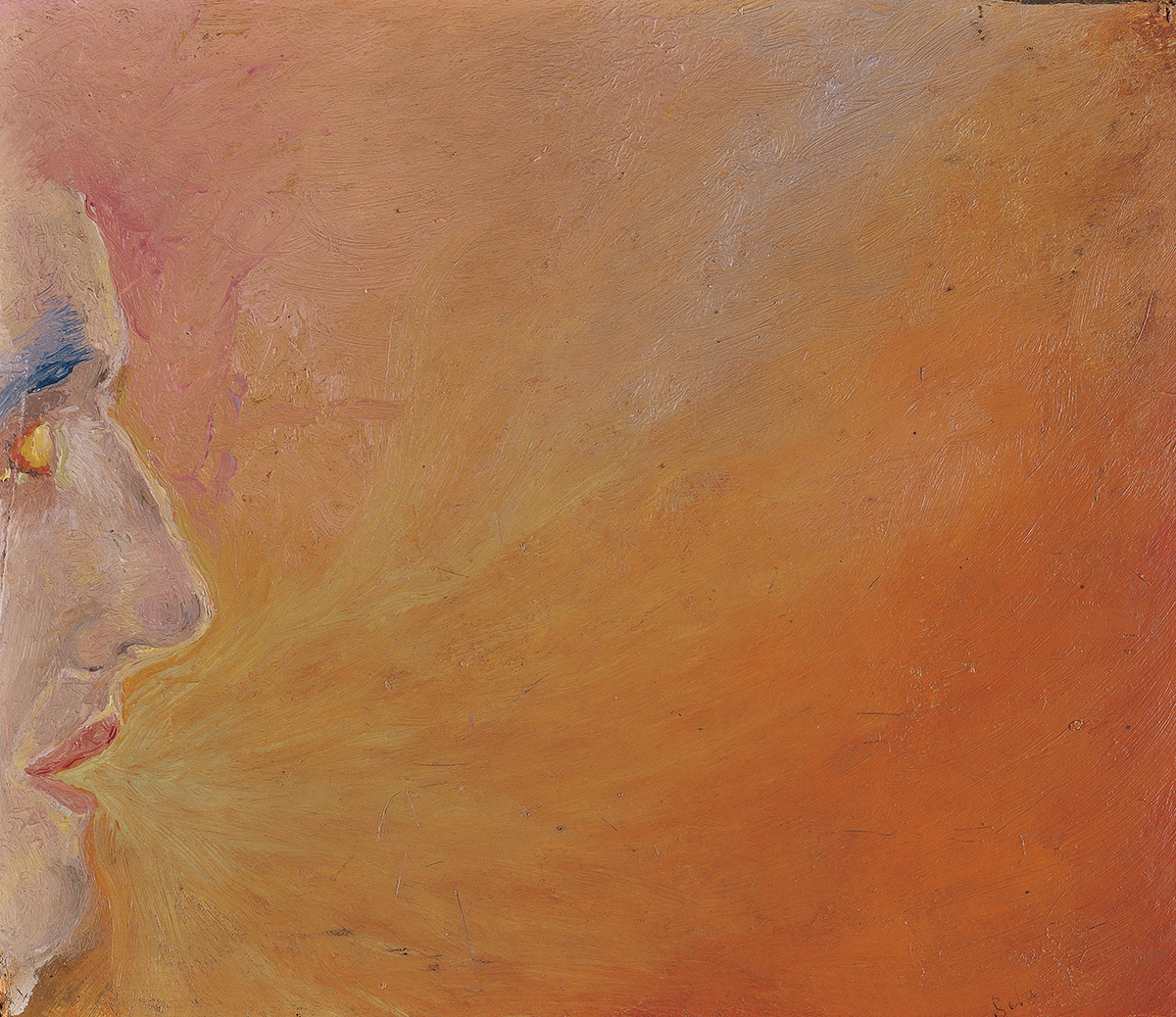
All of the composer’s paintings and drawings owned by the Schoenberg family (Los Angeles and Venice) have recently become the property of the Arnold Schönberg Center Private Foundation.
Arnold Schönberg’s artworks, which have been preserved, studied, and exhibited at the Center where they have been on temporary loan since 1998, comprise 227 paintings and drawings (of which 97 are paintings and 130 are drawings). The estimated value of this extensive donation is approximately 27 million euro.
These artworks serve as important ambassadors for Schönberg’s œuvre as a whole, and have significantly influenced and strengthened the Center’s status as a Viennese cultural institution with an international reputation.
The majority of the paintings and drawings were created in Vienna. Self-portraits, portraits, impressions and fantasies, landscapes, caricatures, stage sets, and designs bear witness to a broad spectrum of artistic expression.
Schönberg interacted with artists of the Vienna Secession, with Oskar Kokoschka, Richard Gerstl, Egon Schiele, Max Oppenheimer, Albert Paris Gütersloh and Carl Moll, and with Wassily Kandinsky, Franz Marc, Gabriele Münter, and Max Liebermann. He regularly visited the Miethke and Pisko galleries, the Hagenbund, and the legendary Viennese art shows of 1908 and 1909, in which fundamental tenets of Viennese Modernism were established and new functional relationships between the arts were explored. Schönberg’s paintings were shown at the first exhibition of “Der Blaue Reiter” [The Blue Rider]in Munich in 1911 as well as alongside paintings by Egon Schiele, Anton Faistauer, and Oskar Kokoschka at the ”Neukunst“ exhibition in Budapest in 1912. In the decades that followed, Schönberg’s artworks – which Schönberg himself described as “making music in colors and forms” – became increasingly acclaimed by curators, academics, and art enthusiasts.
Since the temporary transfer of the collection from Los Angeles to Vienna in 1998, Schönberg’s works have been shown in 165 exhibitions in Europe and the USA. Inspired by the legendary exhibition Dream and Reality in Vienna, the impact of “Vienna 1900” resulted in Schönberg’s paintings as well as the context of their creation being discovered by audiences worldwide through exhibitions in numerous museums.
After the establishment of the Arnold Schönberg Center in 1998, retrospective exhibitions in St. Petersburg in 1999, Moscow, Dresden in 2001, Frankfurt am Main in 2002, Bonn in 2003, Český Krumlov in 2004, Palermo in 2010, and Vienna in 2005 and 2019, amongst others, offered a comprehensive survey of Schönberg’s artworks, which were incorporated within the context of early Austrian Expressionism as well as that of the Russian avant-garde.
Schönberg’s paintings have often been associated with the works of Wassily Kandinsky and “The Blue Rider” (including in Bremen in 2000, New York in 2003, Saint-Tropez in 2006, Prague in 2011, Brussels in 2013, Munich in 2021, and Paris in 2025). The correspondences between Schönberg’s paintings and those of Richard Gerstl have also been addressed several times (New York in 2017, Vienna in 2019, and Zug in 2022). In New York (2004), Amsterdam (2014), Zaragoza (2007), and Paris (2016), Schönberg’s work was incorporated within the broader context of his Jewish identity and religious beliefs. Finally, interdisciplinary exhibitions have focused on the subjects of the Gesamtkunstwerk and synaesthesia (Basel in 1998, Madrid in 2003, and Vilnius in 2009).
Curatorial concepts in Budapest in 2009, Milan and Toulouse in 2010, Dresden and Brno in 2011, Bern and Tampere in 2012, and London in 2013 were dedicated to individual genres of painting and stylistic periods.
Most recently, this year in Vienna, the relationship between Schönberg and Karl Kraus was visualized through a series of paintings and drawings.
Within Austria, artworks on loan from the Arnold Schönberg Center were exhibited in the following museums: Leopold Museum, Österreichische Galerie Belvedere, Jewish Museum Vienna, Kunsthistorisches Museum Wien (Palais Harrach), Sammlung Essl Klosterneuburg, Kokoschka-Haus Pöchlarn, Lentos Museum Linz, Museum der Moderne in Salzburg, Werner Berg Museum Bleiburg, Rabalderhaus Schwaz, and Vorarlberg Museum Bregenz.
The significance of this creative aspect of Arnold Schönberg is documented in a comprehensive bilingual Catalogue raisonné, published by the Center in 2005.
The Arnold Schönberg Center regards this generous donation as an opportunity to dedicate a comprehensive exhibition to the composer’s paintings and drawings for the first time in 20 years: “Painted Music. A Visit to Arnold Schönberg’s Studio” (beginning on March 11, 2025, and curated by the Director of the Collection, Therese Muxeneder).
Schönberg from the viewpoint of contemporaries and successors:
“I would prefer to call Schönberg’s style of painting pure painting.” (Wassily Kandinsky)
“Centuries will likely have to pass before people begin to wonder what Arnold Schönberg’s contemporaries were fretting and fussing about.” (Adolf Loos)
“No one renounced outdated traditions as radically as Schönberg, no one was as radical as he was at that time.” (Hermann Nitsch)

